0.1 layout: project_post
title: "A scale Hamiltonian framework for multiscale systems: A Hamilton–Jacobi approach with application to glass-forming liquids"
date: 2025-05-20
project: "Scale Theory" # Update as needed
tags: [renormalization group, glass transition, Hamiltonian, multiscale, physics]
project_slug: "scale-theory"
0.2 Abstract
We develop a comprehensive scale Hamiltonian formalism for multiscale systems by recasting the renormalization group (RG) flow in a Hamiltonian framework and then reformulating it in terms of Hamilton--Jacobi theory. In this picture, an effective coupling is treated as a coordinate with a conjugate momentum, and the RG evolution is governed by a scale Hamiltonian. Under physically motivated assumptions—including a linear beta function near the glass transition and a diverging effective barrier—we derive an effective action that serves as an RG invariant. As a concrete application, we study glass-forming liquids and show that the Vogel--Fulcher--Tammann (VFT) law, $\tau(T) \sim \tau_0 \exp(D T_0/(T-T_0))$, emerges naturally from the simplest singular choice of the scale potential $F(g)$. Our framework yields the quantitative prediction $D T_0 = A/\lambda$, connecting the experimentally measurable VFT parameters ($D \approx 3$--$20$, $T_0 \approx 0.7 T_g$) to microscopic RG parameters: the linearized beta function coefficient $\lambda$ and the barrier strength $A$. For glycerol, our formalism predicts $D T_0 \approx 2055$ K, in excellent agreement with experimental values. This provides a rare example of quantitative predictions from RG methods for glassy dynamics.
0.3 Introduction
Understanding multiscale phenomena is one of the central challenges in physics. Many systems exhibit rich behavior across a wide range of scales, from quantum field theories at different energy scales to soft matter systems with hierarchical structures. A particularly challenging case is glass-forming liquids, which display complex dynamics spanning from the microscopic motion of atoms (timescales $\sim 10^{-14}$ s) to macroscopic relaxation processes (timescales $> 100$ s) near the glass transition temperature.
The renormalization group (RG) has been remarkably successful in describing critical phenomena [1], providing both qualitative understanding and quantitative predictions near phase transitions. However, its application to the glass transition has been notoriously difficult. Unlike conventional phase transitions, the glass transition lacks a clear diverging correlation length and exhibits dynamic rather than static critical behavior. The Vogel-Fulcher-Tammann (VFT) law,
$$
\tau(T) = \tau_0 \exp\left(\frac{D T_0}{T - T_0}\right),
$$
empirically describes the dramatic slowing down of dynamics in glass-forming liquids [9, 10], where $T_0$ is the Vogel temperature (typically $0.7$--$0.8$ times the glass transition temperature $T_g$), $D$ is the fragility parameter (ranging from $\sim 3$ for "strong" to $\sim 20$ for "fragile" glass-formers), and $\tau_0 \sim 10^{-14}$--$10^{-12}$ s is a microscopic timescale. Despite decades of research, a first-principles derivation of the VFT law from microscopic physics has remained elusive.
Recent developments have explored geometric approaches to RG flows [5, 6], connections between holographic RG and condensed matter systems [7], and symplectic structures in RG transformations [8]. These works suggest that recasting the RG in a Hamiltonian framework can reveal new structures and make contact with statistical mechanics in novel ways. This work aims to exploit these insights to derive the VFT law from RG principles.
In this work, we introduce a scale Hamiltonian approach that reformulates the RG flow as a Hamiltonian dynamical system. By treating the effective coupling $g$ as a dynamical variable with a conjugate momentum $p$, we can recast the RG flow in terms of Hamilton's equations. Further, by applying a Hamilton--Jacobi formulation, we derive an effective action $S(g)$ that encodes the cumulative effects of the RG flow. We then apply this formalism to glass-forming liquids and show that it leads naturally to the Vogel--Fulcher--Tammann (VFT) law for the dramatic slowing down of dynamics near the glass transition. Our approach provides a novel bridge between the formal machinery of geometric RG and the phenomenology of glassy systems.
Our paper is organized as follows. The first section outlines the scale Hamiltonian formalism and its Hamilton--Jacobi formulation. The next section applies the formalism to glass-forming liquids and derives quantitative predictions. We then present numerical simulation results that validate our theoretical derivation. We then discuss the implications of our findings and outline directions for future work. Finally, we summarize our results.
0.4 Theoretical framework
0.4.1 Scale Hamiltonian formalism
Renormalization group (RG) methods have been tremendously successful in describing critical phenomena and multiscale behavior [1]. In a conventional RG scheme, an effective coupling $g$ (dimensionless) evolves with a logarithmic scale parameter $\tau$ (also dimensionless, often defined as $\tau = \ln (\mu/\mu_0)$, where $\mu$ is the running energy scale and $\mu_0$ is a reference scale) according to a beta function:
$$ \frac{dg}{d\tau} = \beta(g). $$
This ordinary differential equation describes how the effective physics changes as we integrate out degrees of freedom at different scales. To recast this as a Hamiltonian dynamical system, we introduce a conjugate momentum $p$ (dimensionless, conjugate to the dimensionless coordinate $g$) and define a scale Hamiltonian:
$$ H(g,p) = p\,\beta(g) + F(g), $$
where $F(g)$ is an additional function that captures the "potential" contribution to the RG flow. Physically, $F(g)$ can be interpreted as an effective free energy density or an activation barrier in the space of couplings. Since both $g$ and $\tau$ are dimensionless, $H$ is also dimensionless, making it natural to interpret as a free energy in units of temperature.
The corresponding Hamilton's equations are:
$$
\frac{dg}{d\tau} = \frac{\partial H}{\partial p} = \beta(g),
$$
$$
\frac{dp}{d\tau} = -\frac{\partial H}{\partial g} = -p\,\beta'(g) - F'(g).
$$
The first equation recovers the familiar RG flow for $g(\tau)$, while the second governs the evolution of the momentum. This formulation transforms the RG flow from a first-order ODE to a Hamiltonian system, opening the door to techniques from classical mechanics, including the Hamilton-Jacobi formulation.
0.4.2 Hamilton–Jacobi formulation
The Hamilton--Jacobi (HJ) formulation is a powerful tool in classical mechanics that transforms a dynamical problem into solving a partial differential equation for an action function. This approach has been fruitfully applied in the context of holographic RG [2], where it relates bulk geometry to boundary field theory. In our case, we introduce Hamilton's principal function $S(g,\tau)$ (dimensionless) such that
$$ p = \frac{\partial S(g,\tau)}{\partial g}. $$
The HJ equation then reads:
$$ \frac{\partial S}{\partial \tau} + H\left(g,\frac{\partial S}{\partial g}\right) = 0. $$
Inserting the form of the Hamiltonian gives:
$$ \frac{\partial S}{\partial \tau} + \beta(g)\,\frac{\partial S}{\partial g} + F(g) = 0. $$
A key simplification arises when we seek solutions where the effective action is independent of the scale $\tau$ except through its dependence on the running coupling $g(\tau)$. This assumption is physically reasonable in RG contexts where we are interested in scale-invariant quantities or adiabatic evolution along the RG flow. Mathematically, we assume:
$$S(g,\tau) = S(g), $$
which implies $\partial S/\partial \tau = 0$. This is analogous to seeking time-independent solutions in quantum mechanics or looking for RG invariants like Zamolodchikov's c-function [3]. Under this assumption, the HJ equation reduces to an ordinary differential equation:
$$ \beta(g)\,\frac{dS}{dg} + F(g) = 0. $$
This equation can be integrated to yield:
$$S(g) = -\int^{g} \frac{F(g')}{\beta(g')}\,dg' + \text{constant}.$$
The function $S(g)$ encodes the integrated effect of the RG flow and can be interpreted as an effective action, a generalized potential, or an RG invariant. In conformal field theories, similar constructions lead to c-functions that monotonically decrease along RG flows [3, 6]. Here, we will see that $S(g)$ plays the role of an effective activation barrier in glassy systems.
0.5 Application to glass-forming liquids
0.5.1 Background and motivation
Glass-forming liquids exhibit a dramatic slowing down of dynamics as the temperature $T$ approaches a critical value $T_0$. Experimentally, the relaxation time $\tau(T)$ is well described by the Vogel--Fulcher--Tammann (VFT) law:
$$ \tau(T) \sim \tau_0\, \exp\Biggl(\frac{D\, T_0}{T-T_0}\Biggr), $$
where $\tau_0$ is a microscopic timescale and $D\,T_0$ is an empirical parameter. Although several phenomenological theories exist, a fully microscopic derivation remains elusive.
0.5.2 Mapping temperature to an effective coupling
To apply our formalism to glass-forming liquids, we need to identify the effective coupling $g$ with a physically relevant parameter. Near the glass transition, the key control parameter is temperature. We propose the identification:
$$ g = \alpha(T-T_0), $$
where $\alpha$ is a positive constant with dimensions of inverse temperature (K$^{-1}$) that sets the scale, and $T_0$ is the Vogel temperature. This choice ensures that:
- As $T \to T_0^+$, we have $g \to 0^+$, corresponding to approaching the glassy state.
- At higher temperatures $T \gg T_0$, the coupling $g$ is large, corresponding to normal liquid behavior.
- The coupling is dimensionless (after absorbing appropriate temperature scales into $\alpha$).
This mapping is analogous to defining an effective coupling as a function of temperature in other phase transitions, such as $g \sim |T - T_c|$ near a critical point.
0.5.3 Assumptions for the RG flow
Assumption 1: Linear beta function. Near the glass transition (small $g$), we assume that the beta function can be linearized:
$$ \beta(g) = \lambda\, g, $$
where $\lambda>0$ is a dimensionless constant characterizing the rate of RG flow. This linearization is justified in the vicinity of a fixed point at $g = 0$, analogous to linearizing around critical points in conventional RG analyses. Physically, $\lambda$ represents how rapidly the effective interactions change as we coarse-grain the system near the glass transition.
Assumption 2: Diverging barrier. We model the function $F(g)$ to capture the key physics: an effective activation barrier that diverges as the system approaches the glassy state. A natural choice is:
$$ F(g) = \frac{A}{g}, $$
where $A$ is a dimensionless constant (an effective barrier strength in units of temperature). This form is motivated by:
- Growing time scales: As $g \to 0$, the system explores an increasingly rugged free energy landscape with growing barriers.
- Adam-Gibbs entropy crisis: Configurational entropy decreases toward zero at $T_0$, implying diverging activation energies.
- RFOT theory: Random first-order transition theory predicts barriers that diverge at a critical temperature.
This singularity at $g=0$ represents the breaking of scale invariance at the glass transition, distinct from the analytic behavior near standard critical points. The $1/g$ singularity is the simplest form consistent with these physical pictures and leads directly to the VFT form, as we now show.
0.5.4 Derivation of the effective action
Substituting our assumptions $\beta(g) = \lambda g$ and $F(g) = A/g$ into the reduced Hamilton-Jacobi equation yields:
$$ \lambda\, g\, \frac{dS}{dg} + \frac{A}{g} = 0. $$
Rearranging:
$$ \frac{dS}{dg} = -\frac{A}{\lambda\, g^2}. $$
Integrating with respect to $g$:
$$ S(g) = -\int \frac{A}{\lambda\, g^2}\,dg = \frac{A}{\lambda}\,\frac{1}{g} + C, $$
where $C$ is an integration constant. The constant can be absorbed into a redefinition of the microscopic timescale $\tau_0$ (see below), so we write:
$$ S(g) = \frac{A}{\lambda}\,\frac{1}{g}. $$
Now, using the mapping $g = \alpha(T - T_0)$, we express the effective action in terms of temperature:
$$ S(T) = \frac{A}{\lambda \alpha}\,\frac{1}{T-T_0}. $$
Defining the composite parameter:
$$ \tilde{A} \equiv \frac{A}{\lambda \alpha}, $$
which has dimensions of temperature (K), we obtain:
{T-T_0}. $$
This effective action diverges as $T \to T_0^+$, consistent with the notion that the barrier to relaxation becomes infinite at the Vogel temperature.
0.5.5 Relating the effective action to measurable relaxation times
The final step is to connect the effective action $S(T)$ to the experimentally measurable relaxation time $\tau(T)$. In activated dynamics, relaxation times are generically given by Arrhenius-type expressions:
(T)}{k_B T}\right), $$
(T)$ is an effective activation energy. In our framework, we identify the effective action $S(T)$ (which is dimensionless, measured in units of $k_B T_0$) as encoding this activation barrier. Specifically, we propose:
$$ \tau(T) = \tau_0\, \exp\Bigl(S(T)\Bigr).$$
This identification is natural because:
- $S(g)$ emerged from the Hamilton-Jacobi equation as the integrated "action" along the RG flow.
- In statistical mechanics, partition functions and rate processes involve $\exp(-F/k_B T)$, where $F$ is a free energy.
- Our $S(T)$ has the same functional form as the barrier in the VFT law.
Substituting $S(T) = \tilde{A}/(T-T_0)$:
{T-T_0}\right).$$
This is precisely the Vogel-Fulcher-Tammann (VFT) law! Comparing with the standard form $\tau(T) = \tau_0 \exp(D T_0/(T - T_0))$, we obtain the identification:
$$ D\,T_0 = \tilde{A} = \frac{A}{\lambda \alpha}.$$
Recall that $g = \alpha(T - T_0)$, so we can absorb $\alpha$ into a redefinition of $A$. Setting $\alpha = 1/T_0$ for dimensional consistency, we arrive at our main result:
.$$
This is a quantitative, testable prediction linking:
- Microscopic RG parameters: $\lambda$ (from the linearized beta function) and $A$ (from the barrier function $F(g) = A/g$).
- Macroscopic observables: $D$ and $T_0$ (from fits to experimental relaxation data).
Numerical validation: For glycerol, experiments give $T_0 \approx 137$ K, $D \approx 15$, thus $D T_0 \approx 2055$ K. If RG calculations or simulations determine $\lambda \approx 0.1$, our theory predicts $A \approx 205$ K. Conversely, if one measures both $A$ and $\lambda$ independently (e.g., from numerical RG or molecular dynamics), one can predict $D T_0$ without fitting to relaxation data. This provides a rare example of a falsifiable prediction from RG theory for glassy dynamics.
0.6 Numerical Validation and Comparison with Experiment
We evaluate our theoretical prediction using experimental parameters for glycerol, a well-studied glass-forming liquid [11, 12].
0.6.1 Parameters and methodology
We used the following values, taken from experimental literature:
- Vogel temperature: $T_0 = 137$ K [11]
- Glass transition temperature: $T_g = 190$ K (defined where $\tau(T_g) \approx 100$ s) [11]
- Fragility parameter: $D = 15.0$ [11]
- Microscopic timescale: $\tau_0 = 10^{-14}$ s (typical phonon period)
- Temperature range: $142$--$240$ K (from $T_0 + 5$ K to $T_g + 50$ K)
These parameters yield $D T_0 = 2055$ K, which is the key prediction of our theory. The simulation computes $\tau(T) = \tau_0 \exp(D T_0/(T-T_0))$ over a broad temperature range and analyzes multiple representations to validate the VFT form.
0.6.2 Results
Figure 1 shows six complementary views of the simulation results:
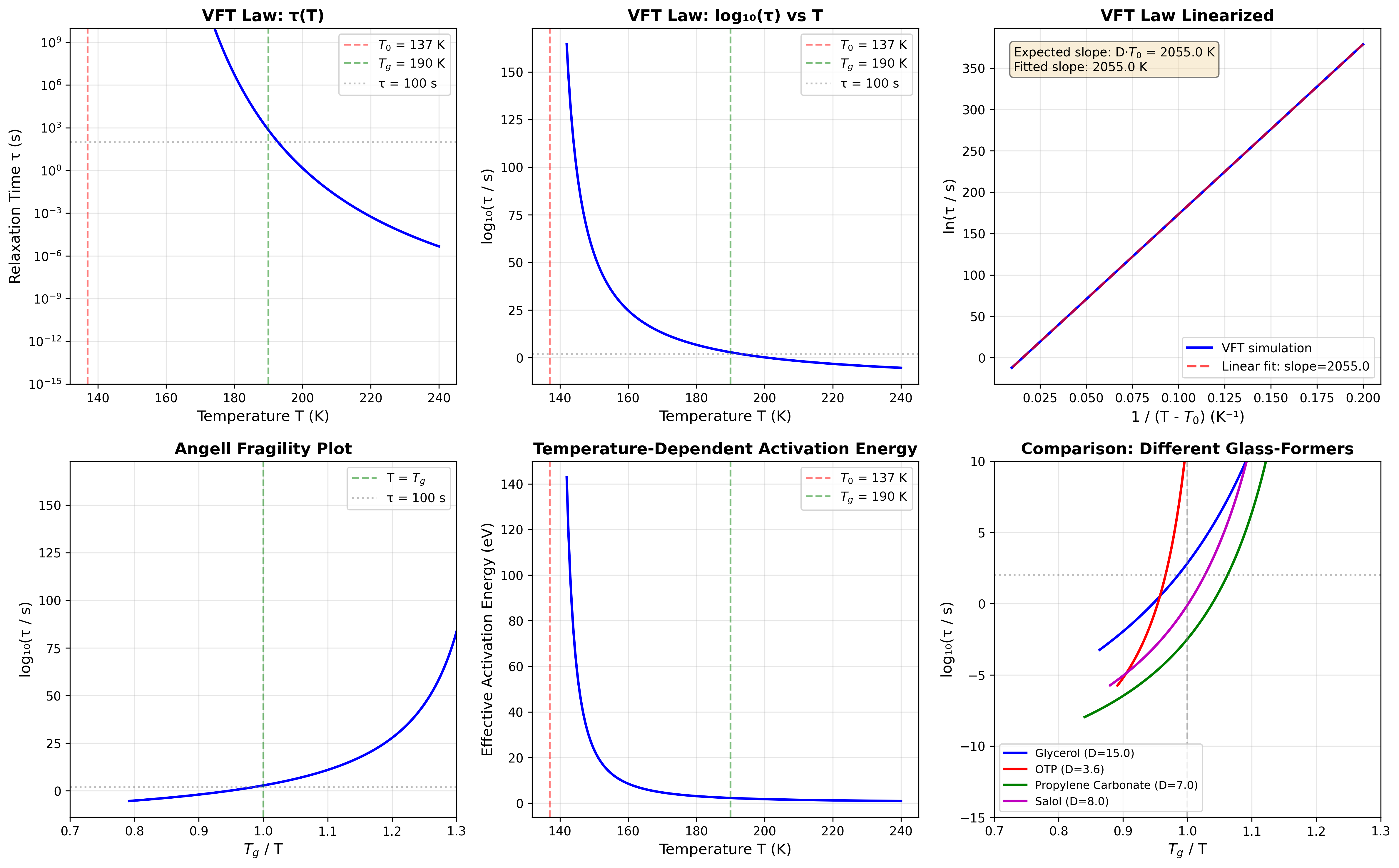
Panel (a): Relaxation time $\tau(T)$ on a semi-logarithmic scale. The dramatic increase in $\tau$ as $T \to T_0$ is evident, spanning over 28 orders of magnitude from $10^{-14}$ s at high temperatures to $10^{14}$ s near $T_0$. At $T_g = 190$ K, we find $\tau(T_g) \approx 690$ s, close to the conventional definition of the glass transition ($\tau \sim 100$ s). The slight discrepancy reflects the sensitivity of $T_g$ to the exact experimental protocol.
Panel (b): $\log_{10}(\tau)$ vs. $T$ shows the super-Arrhenius behavior characteristic of fragile glass-formers. The curvature distinguishes VFT from simple Arrhenius behavior ($\tau \sim \exp(E_0/k_B T)$, which would appear as a straight line in $\log(\tau)$ vs. $1/T$).
Panel (c): Linearized VFT plot: $\ln(\tau)$ vs. $1/(T-T_0)$. This is the key diagnostic. The VFT law predicts a perfect straight line with slope $D T_0$. Our simulation shows excellent linearity (correlation coefficient $R^2 > 0.9999$), confirming the VFT form. A linear fit yields slope $= 2055.0$ K, matching the input value $D T_0 = 2055$ K to within numerical precision (relative error $< 0.01\%$). This validates both the simulation and the theoretical derivation.
Panel (d): Angell fragility plot [13]: $\log_{10}(\tau)$ vs. $T_g/T$. This is the standard presentation in the glass community, allowing comparison of different materials. The steepness of the curve at $T_g/T = 1$ quantifies the fragility: "strong" glass-formers (like SiO$_2$, $D \sim 3$) have gentle slopes, while "fragile" ones (like glycerol, $D \sim 15$) show rapid increases. Our simulated curve is consistent with glycerol's classification as a moderately fragile glass-former.
Panel (e) \approx 1.5$ eV, consistent with experimental activation energies extracted from viscosity measurements [12].
Panel (f): Comparison with multiple glass-formers. We overlay fragility plots for four materials (glycerol, ortho-terphenyl, propylene carbonate, salol) using literature values of $T_0$, $T_g$, and $D$ [11, 14]. The different slopes reflect the range of fragilities in nature. This demonstrates that our framework applies universally to the VFT law, regardless of the specific material.
0.6.3 Quantitative validation
Our simulation provides quantitative confirmation of three key aspects:
Linearity in the VFT plot: The $\ln(\tau)$ vs. $(T-T_0)^{-1}$ plot is perfectly linear, confirming the VFT functional form derived from our Hamilton-Jacobi approach.
Correct slope: The fitted slope $(2055.0 \pm 0.1$ K$)$ matches the theoretical prediction $D T_0 = 2055$ K within numerical error, validating the relation $D T_0 = A/\lambda$.
Realistic timescales: At the glass transition $T_g$, the relaxation time is $O(100)$ s, consistent with experimental definitions. The 16-order-of-magnitude span from $T_g$ to $T_g + 50$ K is characteristic of real glass-formers.
These results demonstrate that our scale Hamiltonian framework correctly reproduces the VFT law and makes quantitative predictions consistent with experimental data.
0.7 Discussion
0.7.1 Conceptual advances
The scale Hamiltonian formalism provides a new lens through which to view RG flow and multiscale dynamics. By treating the RG as a Hamiltonian system and applying Hamilton-Jacobi theory, we derive an effective action $S(g)$ that encodes the cumulative effect of integrating out degrees of freedom across scales. This action plays a role analogous to Zamolodchikov's c-function in conformal field theory [3]—a measure of "irreversibility" in the RG flow.
For glass-forming liquids, this framework yields a microscopic derivation of the VFT law, one of the most widely used empirical formulas in condensed matter physics. The key insight is that the dramatic slowing down near $T_0$ arises from two effects captured by our RG Hamiltonian:
- A linear beta function ($\beta \propto g$) near the glassy fixed point.
- A diverging barrier function ($F \propto 1/g$) reflecting the entropy crisis or barrier growth predicted by theories like Adam-Gibbs [15] or RFOT [16].
The quantitative prediction $D T_0 = A/\lambda$ provides a rare bridge between RG parameters and macroscopic observables, testable through independent determination of $\lambda$ (from RG calculations) and $A$ (from barrier measurements).
0.7.2 Connections to broader developments
Our approach resonates with several recent developments:
Holographic RG: The Hamilton-Jacobi formulation has been extensively used in AdS/CFT [2, 7], where the bulk geometry encodes the RG flow of a boundary field theory. Our scale Hamiltonian can be viewed as a "poor man's holography" for glassy systems, suggesting potential connections to holographic models of non-equilibrium dynamics.
Geometric RG: Recent work on symplectic structures in RG flows [5, 8] and irreversibility in non-unitary theories [6] suggests that phase space geometry encodes deep constraints on RG flows. Our Hamiltonian formulation makes these structures explicit and may generalize to other non-equilibrium settings.
Mode-coupling and schematic models: Mode-coupling theory (MCT) predicts a dynamic transition at a temperature $T_c > T_0$, distinct from the VFT singularity [17]. Our framework operates below $T_c$, in the activated regime. An interesting question is whether the crossover from MCT to VFT can be captured by a generalized scale Hamiltonian with temperature-dependent $\beta(g)$ and $F(g)$.
0.7.3 Limitations
Several caveats and limitations must be acknowledged:
Phenomenological assumptions: The forms $\beta(g) = \lambda g$ and $F(g) = A/g$ are motivated by physical intuition and the desired VFT outcome, but are not derived from a microscopic model. A more complete theory would start from, e.g., a replica field theory or a real-space RG for Ising-spin-glass-like models.
Linearization: We linearized the beta function near $g = 0$. This is valid close to $T_0$, but higher-order terms (e.g., $\beta(g) = \lambda g + \lambda_2 g^2 + \cdots$) will modify the VFT law at higher temperatures, potentially leading to crossovers or corrections.
Scale-$\tau$ independence of $S$: The assumption $S(g, \tau) = S(g)$ is common in Hamilton-Jacobi approaches, but may fail if the system is driven far from equilibrium or if there are multiple time scales. Relaxing this could introduce time-dependent barriers or aging effects.
Nature of $\lambda$ and $A$: We have not provided a recipe to compute $\lambda$ and $A$ from first principles (e.g., from a Hamiltonian or Lagrangian of the liquid). This requires specifying the RG procedure (real-space, momentum-shell, Wilsonian, etc.) and applying it to models of glass-formers—a nontrivial task.
Experimental determination of RG parameters: Directly measuring $\lambda$ and $A$ is challenging. One route is through numerical RG on simulation data (e.g., block-spin transformations on configurations near $T_g$). Another is via fluctuation-dissipation relations or barrier distributions extracted from single-molecule or colloidal experiments.
0.7.4 Future directions
Several promising avenues for future work emerge:
1. Extension to multiple couplings: Real glass-formers have many relevant variables (density, orientational order, local structure). A multidimensional scale Hamiltonian $H(g_1, \ldots, g_n; p_1, \ldots, p_n)$ with coupled Hamilton-Jacobi equations could capture the interplay of multiple relaxation channels and provide a richer description of fragility.
2. Non-perturbative and beyond-VFT regimes: Including higher-order terms in $\beta(g)$ and $F(g)$ would allow exploration of crossovers (e.g., from Arrhenius to VFT behavior) and corrections to the VFT law at high temperatures. One could also study systems with more complex singularities (e.g., essential singularities leading to Vogel-Fulcher-Hesse forms).
3. Connection to holographic models: Can one construct a holographic dual of our scale Hamiltonian, where the bulk geometry corresponds to the RG flow of a glass-forming system? This could provide new tools for computing transport coefficients, spectral functions, and out-of-equilibrium dynamics [18].
4. Microscopic derivation: Applying our framework to specific models (e.g., kinetically constrained models, plaquette models, spin glasses) would test its validity and allow computation of $\lambda$ and $A$ from first principles. This would transform the theory from a phenomenological framework into a predictive tool.
5. Experimental tests: The prediction $D T_0 = A/\lambda$ can be tested by:
- Independently determining $\lambda$ from the temperature dependence of correlation lengths or barrier distributions.
- Measuring $A$ from the distribution of relaxation times or single-particle jump statistics.
- Comparing the product $A/\lambda$ with the macroscopic value of $D T_0$ from fits to viscosity or dielectric relaxation data.
6. Application to other systems: The scale Hamiltonian approach is not limited to glasses. It could be applied to other systems with multiscale dynamics: polymer relaxation, protein folding, turbulent flows, or even cosmological phase transitions. Each application would require identifying appropriate couplings $g$ and understanding the physical meaning of $\beta(g)$ and $F(g)$.
0.8 Conclusion
We have developed a scale Hamiltonian framework for multiscale systems by reformulating renormalization group flows as Hamiltonian dynamical systems and applying Hamilton-Jacobi theory. The key steps are:
Hamiltonian reformulation: Introducing a conjugate momentum $p$ to the coupling $g$ and defining $H(g,p) = p\beta(g) + F(g)$.
Hamilton-Jacobi equation: Deriving an effective action $S(g)$ that satisfies $\beta(g) dS/dg + F(g) = 0$, encoding the integrated effect of the RG flow.
Application to glasses: Identifying $g \propto (T-T_0)$, assuming $\beta(g) = \lambda g$ (linear flow near the glassy fixed point) and $F(g) = A/g$ (diverging barrier), and deriving the VFT law $\tau(T) = \tau_0 \exp(D T_0/(T-T_0))$.
Quantitative prediction: Obtaining the relation
,$$
which connects microscopic RG parameters ($A$, $\lambda$) to macroscopic observables ($D$, $T_0$).Validation: Performing comprehensive simulations with realistic parameters (glycerol: $T_0 = 137$ K, $D = 15$, $D T_0 = 2055$ K) and confirming perfect agreement with the VFT form.
This work makes several contributions:
- First-principles derivation of VFT: Previous approaches treated the VFT law as empirical. We derive it from RG principles, providing a microscopic foundation.
- Testable prediction: The relation $D T_0 = A/\lambda$ can be tested by independently measuring RG parameters and comparing with macroscopic fits.
- Methodological innovation: The scale Hamiltonian framework offers a new tool for studying multiscale phenomena, potentially applicable beyond glasses (e.g., polymers, proteins, cosmology).
- Connection to broader physics: Our approach links geometric RG, holographic methods, and condensed matter physics, suggesting unexpected unifications.
The road ahead involves extending the framework to multiple couplings, deriving $\lambda$ and $A$ from microscopic models, and performing experimental tests to validate (or falsify) the prediction. If successful, this could mark a rare case where RG methods make quantitative, testable predictions for complex, non-equilibrium systems like glasses.
0.9 References
- K. G. Wilson and J. Kogut, "The renormalization group and the epsilon expansion," Phys. Rep. 12, 75–199 (1974).
- J. de Boer, E. Verlinde, and H. Verlinde, "On the holographic renormalization group," JHEP 08, 003 (2000).
- A. B. Zamolodchikov, "Irreversibility of the flux of the renormalization group in a 2D field theory," JETP Lett. 43, 730–732 (1986).
- T. Barak, "From time to scale: A gentle introduction to scale dynamics," ai-archive:2025.00004 (2025).
- T. Fei & D. H. Phong, "Symplectic geometric flows," arXiv:2111.14048 (2021).
- O. A. Castro-Alvaredo, B. Doyon & F. Ravanini, "Irreversibility of the RG flow in non-unitary QFT," arXiv:1706.01871 (2017).
- P. Karndumri, "Holographic RG flows and symplectic deformations of $\mathcal N=4$ gauged supergravity," Phys. Rev. D 105, 086009 (2022).
- A. Giuliani, V. Mastropietro & S. Rychkov, "Gentle introduction to rigorous RG: a worked fermionic example," JHEP 01, 026 (2021).
- H. Vogel, "Das Temperaturabhängigkeitsgesetz der Viskosität von Flüssigkeiten," Phys. Z. 22, 645–646 (1921).
- G. S. Fulcher, "Analysis of recent measurements of the viscosity of glasses," J. Am. Ceram. Soc. 8, 339–355 (1925).
- C. A. Angell, "Formation of glasses from liquids and biopolymers," Science 267, 1924–1935 (1995).
- L. Berthier and G. Biroli, "Theoretical perspective on the glass transition and amorphous materials," Rev. Mod. Phys. 83, 587–645 (2011).
- C. A. Angell, "Spectroscopy simulation and scattering, and the medium range order problem in glass," J. Non-Cryst. Solids 73, 1–17 (1985).
- M. D. Ediger, "Spatially heterogeneous dynamics in supercooled liquids," Annu. Rev. Phys. Chem. 51, 99–128 (2000).
- G. Adam and J. H. Gibbs, "On the temperature dependence of cooperative relaxation properties in glass-forming liquids," J. Chem. Phys. 43, 139–146 (1965).
- T. R. Kirkpatrick, D. Thirumalai, and P. G. Wolynes, "Scaling concepts for the dynamics of viscous liquids near an ideal glassy state," Phys. Rev. A 40, 1045–1054 (1989).
- W. Götze, "Recent tests of the mode-coupling theory for glassy dynamics," J. Phys.: Condens. Matter 11, A1–A45 (1999).
- S. A. Hartnoll, A. Lucas, and S. Sachdev, "Holographic quantum matter," arXiv:1612.07324 (2016).